
Top 10 Destinations in Mongolia: The Complete 2026 Guide
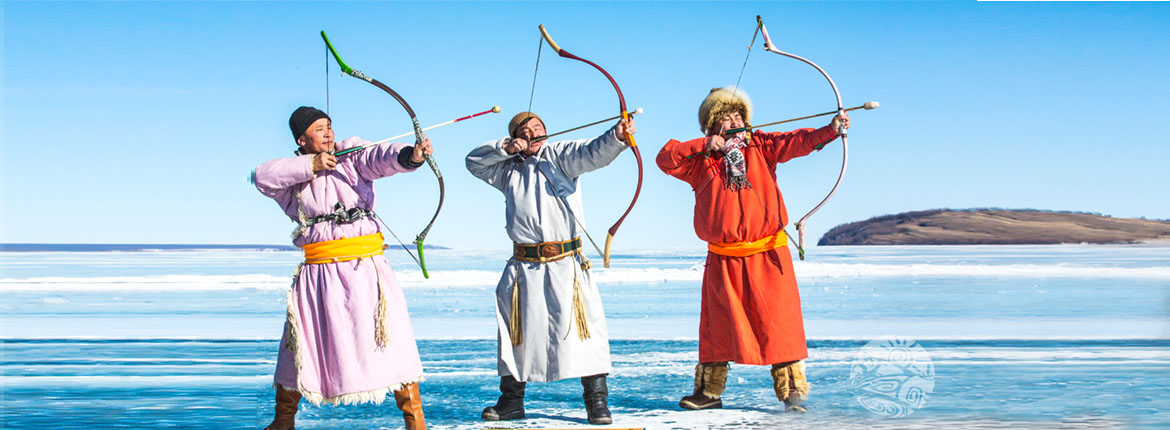
Mongolian archery is one of the three sacred games of the Naadam Festival, alongside wrestling and horse racing. There are three traditional styles: Khalkh (men shoot 75m, women 60m), Buriad (30–45m, mixed gender), and Uriankhai (30–40m, men only). The traditional Mongolian bow is a composite recurve made from wood, horn, and sinew. Tourists can try archery at most ger camps and cultural centres throughout Mongolia.
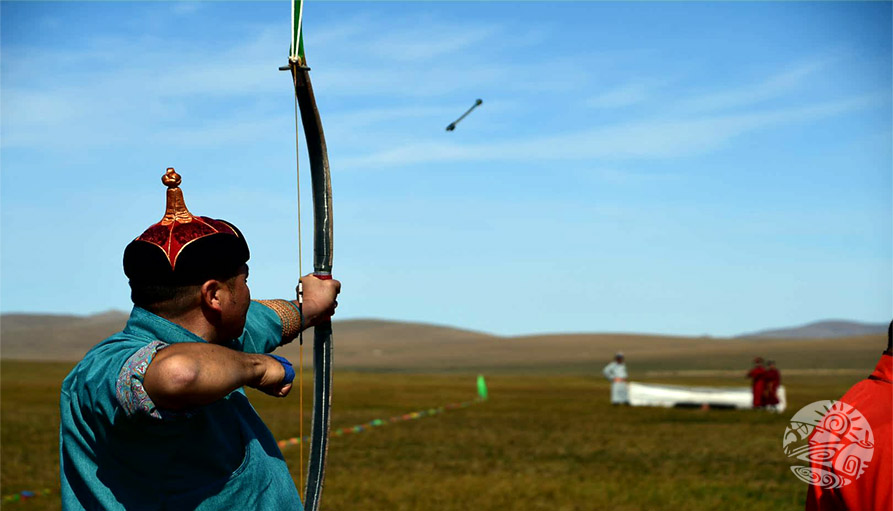
An archer draws back a composite bow of wood, horn, and sinew — a design refined over millennia of steppe warfare. Seventy-five metres away, a row of small leather cylinders sits on the ground. The arrow flies in a flat trajectory, barely arcing, and the crowd erupts: "Khurai! Khurai! Khurai!" — the traditional cheer that has rung out across Mongolian archery grounds for centuries. This is traditional Mongolian archery at its finest, and watching it at the Naadam Festival is one of the most viscerally thrilling sporting experiences in the world.
Archery is not merely a sport in Mongolia. It is one of the three sacred games — the Eriin Gurvan Naadam (Эрийн гурван наадам), or "Three Manly Games" — alongside wrestling and horse racing, that define Mongolian identity and have been practised at national festivals since the time of the Mongol Empire. It is a military art, a cultural tradition, a family sport, and a living connection to the warriors who once used the same fundamental techniques to conquer from Korea to Hungary.
Mongolian archery has a documented history of at least 4,000 years. Bronze Age rock carvings found in caves and cliff faces across Mongolia depict figures with bows, and excavated burial sites from the 2nd millennium BCE include composite bow fragments. The bow was the defining weapon of the steppe peoples — not just in Mongolia but across the entire Eurasian steppe, from the Scythians and Huns to the Mongols.
The military application reached its apex under Genghis Khan (c. 1162–1227). Mongol cavalry archers could fire 10 or more accurately aimed arrows per minute at full gallop — a rate of fire that bewildered and overwhelmed every army they encountered from China to Eastern Europe. The Mongol composite bow had an effective range of up to 300 metres and could penetrate armour at shorter distances [this is a reasonable, conservative figure — some sources describing individual feats of skill, including a stone inscription attributed to the archer Esungge in 1226, claim single shots well beyond 500 metres, though such extreme distances are debated among historians and not representative of typical combat range]. It was a technological marvel of its time, and the skill required to use it effectively was built through years of training beginning in early childhood.
Today, archery remains a living sport practised by thousands of Mongolians year-round, not just at festivals. The National Archery Federation of Mongolia has over 12,000 registered members (2024) [this specific figure could not be independently verified. The most detailed public data found — from the Mongolian Traditional Archery Federation — cites roughly 2,000 archers registered across 21 provinces, with total competition participation exceeding 10,000. Recommend double-checking this number against the Federation's current published figures before publishing]. UNESCO inscribed Mongolian Naadam — including its archery competition — on the Intangible Cultural Heritage of Humanity list in 2010, recognising it as a tradition of global cultural significance. [Confirmed: the inscription date was specifically November 16, 2010.]
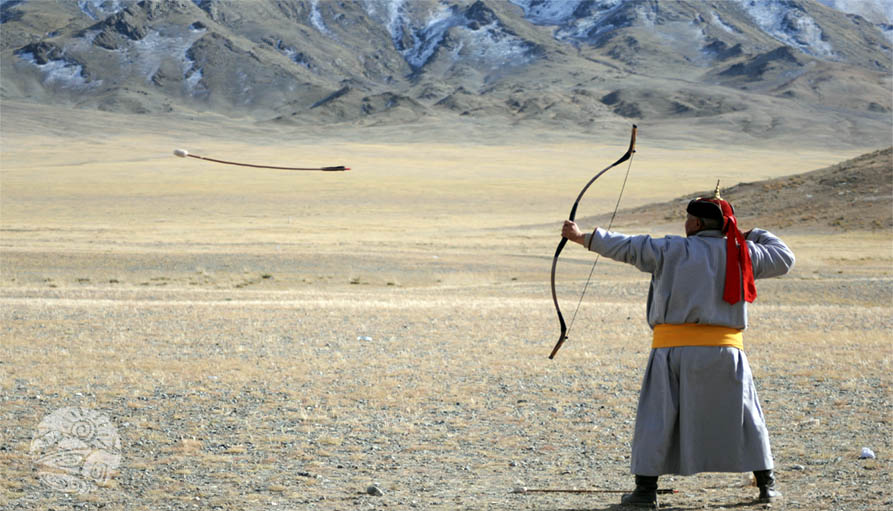
The Khalkh style is the most widespread and is the form used at the National Naadam Festival in Ulaanbaatar. It represents the archery tradition of the Khalkh Mongols — the dominant ethnic group comprising approximately 82% of Mongolia's population.
Practised by the Buryat Mongolians — a community found primarily in northern Mongolia near the Russian border and across the border in Buryatia (Russia). The Buriad style preserves a distinct archery tradition different from the national Khalkh form.
The Uriankhai style is practised by the Uriankhai people of western Mongolia, primarily in Uvs province. It is the most distinctly ethnic of the three styles, preserved by a specific community as part of their cultural identity.
The traditional Mongolian bow is a composite recurve bow — one of the most sophisticated bow designs in human history and the product of thousands of years of refinement. The term "composite" refers to the use of multiple materials working in concert, each contributing different mechanical properties:
The combination of these materials — wood providing shape, sinew providing tension return, and horn resisting compression — produces a bow that stores far more energy per unit length than a simple wooden bow. Mongolian composite bows are significantly shorter than English longbows (typically 120–150 cm unstrung), making them ideal for mounted archery.
The archery competition at Naadam runs over three days, held at the dedicated archery grounds adjacent to the main Naadam Stadium in Ulaanbaatar. Over 300 archers typically participate, competing in teams of 10.
The structure of the competition:
Watching the archery competition is one of Naadam's most atmospheric experiences. The combination of skilled technique, traditional costume, ceremonial calling, and crowd participation creates something that feels simultaneously ancient and completely alive.
In traditional Tengrist belief — Mongolia's pre-Buddhist shamanic religion — the bow carries deep spiritual meaning, connected to male power and the ability to impose intention on the world. Arrows are symbolic of directed will. Some shamanic ritual traditions involve shooting arrows as acts of protection or invocation. The connection between archery and the spiritual world is not merely metaphorical — it is embedded in the structure of ceremony.
The title "Mergen" (мэргэн) — meaning skilled marksman, or by extension "wise one" — is one of the most common Mongolian surnames, a reminder of the time when prowess with the bow was the highest measure of a man. Mongolian children — particularly boys — begin learning to shoot from the age of 5 or 6. By the age of 10, many can accurately hit targets at 20–30 metres. Archery schools exist in Ulaanbaatar and in provincial centres across the country.
Competitive archery is also a profoundly social event — families attend together, elders judge and explain the finer points to younger generations, and children watch with intense concentration. It functions as both entertainment and cultural transmission.
The most accessible option for most visitors. The majority of tourist ger camps — from those near Ulaanbaatar to camps in the Gobi and Khangai regions — offer archery as a standard activity. A camp staff member provides basic instruction, traditional bows are available, and a target is set at 20–30 metres. Sessions typically last 30–60 minutes and cost nothing or $5–10 as an add-on. This is the recommended introduction for all visitors.
Blue Sky Archery Club and several similar establishments in Ulaanbaatar offer structured lessons for visitors. Sessions of 1–2 hours with English-speaking instruction are available at a cost of approximately $15–30 per session. Contact can be arranged through your hotel or tour operator. These sessions go further in explaining technique and the cultural context of the sport.
For serious visitors, the National Archery Federation can arrange formal lessons and — at certain times of year — access to local competitions where foreign participants are welcomed as observers or occasional participants. This is the best option for anyone with a background in archery who wants to engage with Mongolian practitioners at a competitive level.
Attending Naadam in Ulaanbaatar (typically July 11–13) gives access to the country's most important archery competition. Entry to the archery grounds is included in the Naadam ticket. The atmosphere — costumes, ceremonial calling, crowd participation — is extraordinary and entirely different from watching archery in a Western sporting context. Access to VIP positions near the archery range can be arranged through a tour operator.
Is Mongolian archery different from Olympic archery?
Yes — significantly so. Olympic archery uses modern recurve or compound bows fitted with electronic or mechanical sights, stabilisers, and clickers. Targets are large paper rings mounted vertically at precise distances. Mongolian traditional archery uses composite recurve bows with no sights, no stabilisers, and no mechanical aids. The targets are small leather cylinders (surs) arranged on the ground, and the shooting distances are traditional rather than standardised to Olympic rules. Most importantly, the ceremonial, cultural, and communal dimensions of Mongolian archery are inseparable from the sport itself — something that has no equivalent in the Olympic format.
Can women participate in Mongolian archery?
Yes — women compete actively in both Khalkh and Buriad styles. At Naadam, women shoot at 60 metres with 20 surs targets (compared to 75 metres and 33 surs for men). Female archers are respected and celebrated. The Uriankhai style is the only traditional form that is men-only by convention. Mongolia has produced accomplished female archers who also compete in international recurve events.
How old do children start learning archery in Mongolia?
Many Mongolian children begin learning to shoot from the age of 5–6. By age 10, a child who has practised regularly can often hit targets accurately at 20–30 metres. This early start reflects archery's role as a fundamental cultural competency, not merely a sport. Archery schools and clubs operate in Ulaanbaatar and provincial centres, and archery is part of physical education in some Mongolian schools. At Naadam there is a dedicated children's archery competition.
What is a "sur" in Mongolian archery?
A sur (сур) is the small cylindrical leather target used in Mongolian archery. Each sur is approximately 4–5 cm in diameter and 10 cm tall — about the size of a thick highlighter pen. They are arranged in a horizontal row on the ground (33 for men's Khalkh competitions, 20 for women's). The archer must knock the sur out of position — a direct hit that moves the sur is scored. When a sur is hit, the uuchin (judge) calls out in a distinctive chant and the crowd responds with "Khurai!" The sound and ceremony of a successful shot are as important as the score itself.
Is there a Mongolian archery world record?
Traditional Mongolian archery is governed by Mongolia's National Archery Federation rather than World Archery (the Olympic governing body), so records are maintained separately. Mongolia does participate in international Olympic-style recurve and compound archery events. Some Mongolian archers compete internationally in both traditional and Olympic formats. Within Mongolia, the highest competitive achievement in traditional archery is the title of Mergen — a historic distinction that carries considerable social prestige.
Can I buy a traditional Mongolian bow as a souvenir?
Yes — traditional Mongolian bows are available in Ulaanbaatar at the State Department Store, Naran Tuul Market (the "Black Market"), and specialist archery shops. Display/decorative bows cost $50–300 USD. Functional traditional composite bows made by master bowyers cost $300–1,500 USD. If you intend to take a functional bow home, check your country's customs regulations regarding importing composite bows. Your tour operator can advise on the correct paperwork for export from Mongolia.
What should I say to an archer at Naadam?
The traditional cheer when an arrow hits its target is "Khurai! Khurai! Khurai!" — three times, enthusiastically. You can join in with the crowd without hesitation. Approaching an archer before or after competition to compliment their performance is warmly welcomed — a thumbs-up, a genuine smile, and showing real curiosity about their bow and equipment will usually open a conversation. Many competitive archers speak some English and are proud to share their knowledge with interested foreign visitors.